
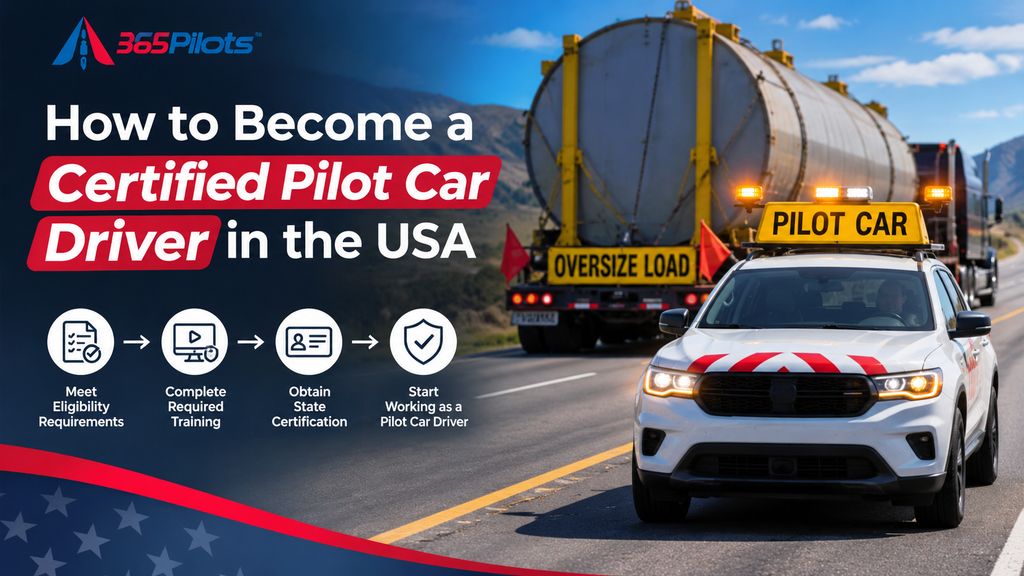
Becoming a pilot car driver can open the door to a specialized career in the heavy haul transportation industry. From escorting construction machinery to supporting the movement of wind turbine components, pilot car operators play an important role in keeping oversized shipments and other road users safe.
To become a certified pilot car driver in the United States, you generally need a valid driver’s license, approved Pilot/Escort Vehicle Operator (PEVO) training, and successful completion of the required certification examination. Depending on where you operate, you may also need additional permits, insurance and safety qualifications.
However, pilot car certification is not standardized nationwide. Each state has its own requirements, and a certification accepted in one state may not automatically be recognized in another.
Understanding these differences before investing in training can save you time, money and unnecessary complications as you begin your career.
What Does a Pilot Car Driver Do?
A pilot car driver, also known as a Pilot/Escort Vehicle Operator (PEVO), accompanies oversize and overweight vehicles to help protect the shipment, transportation team, infrastructure and surrounding traffic.
Depending on the assignment, pilot car drivers may travel ahead of or behind the transport vehicle.
Their responsibilities can include:
- Warning motorists about approaching oversize loads.
- Identifying potential road hazards.
- Communicating with the truck driver and transportation team.
- Monitoring overhead clearance and road restrictions.
- Providing authorized traffic control assistance.
- Conducting route surveys and pre-trip inspections.
Unlike the truck driver transporting the cargo, the pilot car operator focuses on identifying risks and supporting the safe movement of the shipment.
The role requires good judgment, effective communication and an understanding of state transportation regulations.
Basic Requirements to Become a Pilot Car Driver
Before registering for a certification course, check whether you meet the eligibility requirements of the state in which you intend to operate.
Although requirements differ, prospective pilot car drivers should generally be prepared to provide:
- A valid driver’s license.
- Evidence that they meet the applicable minimum age requirement.
- An acceptable driving record where required.
- Proof of completing approved training.
- Evidence of passing a certification examination.
- Appropriate insurance and vehicle documentation where applicable.
Minimum age requirements are not the same everywhere. Some certification programs accept applicants aged 18 or older, while others require drivers to be at least 21.
A commercial driver’s license (CDL) is not generally required for standard pilot car operations, provided the escort vehicle does not independently require one. However, specialized transportation assignments may have additional qualifications.
Always check the relevant state’s requirements before paying for a training course.
How to Become a Certified Pilot Car Driver in 7 Steps

Step 1: Check Your State’s Certification Requirements
Start by identifying the certification requirements in your home state and the states where you expect to work.
This is particularly important if you plan to escort shipments across state lines.
Some states accept certifications issued by other jurisdictions, while others require their own credentials or additional documentation.
Understanding where you intend to operate will help you select a certification that meets your professional needs.
Step 2: Choose an Approved Pilot Car Training Program
Once you understand the applicable requirements, find a training provider approved by the relevant state authority.
Pilot car certification courses typically cover permit interpretation, escort responsibilities, communication procedures, hazard recognition, route planning, emergency response and vehicle equipment requirements.
Some programs offer online training, while others require classroom attendance or a separate examination at an approved testing location.
For example, the Washington State Department of Transportation publishes information about its approved training providers.
Before registering, confirm which state certification the course provides, where it is recognized and whether additional assessments are necessary.
Step 3: Complete Your Training and Certification Exam
Approved pilot car training introduces the regulations and operating procedures that professional escort drivers need to understand.
Course duration and examination requirements vary by state.
Under Washington Administrative Code 468-38-100, applicants complete eight hours of initial instruction and must achieve at least 80% on the written examination.
Passing the examination demonstrates that you understand the foundational requirements of pilot car operations. It does not, however, replace the practical experience needed to manage complex transportation situations.
Step 4: Obtain Your Certification Card
After meeting the applicable requirements, you will receive a certification card, certificate or driver’s license endorsement.
The exact format depends on the issuing state.
Review your documentation to confirm the personal information, issuing authority and expiration date are correct.
Keep your certification accessible during assignments, as transportation authorities, carriers or dispatchers may request proof of your qualifications.
You should also maintain copies of any additional training credentials, permits and insurance documentation relevant to your work.
Step 5: Arrange Appropriate Pilot Car Insurance
If you intend to work independently, insurance should be one of your earliest considerations.
A personal automobile insurance policy may not cover commercial pilot car activities. Speak with an insurance provider that understands escort vehicle operations and can explain the coverage available for your intended services.
Requirements may differ by state, customer and assignment.
Make sure your policy explicitly covers the work you intend to perform, rather than assuming that ordinary vehicle coverage is sufficient.
Step 6: Prepare Your Pilot Car and Safety Equipment
Your escort vehicle must comply with the requirements of the states in which you operate.
Common pilot car equipment includes warning signs, amber warning lights, two-way communication equipment, safety flags and emergency response supplies.
Certain assignments may also require specialized equipment, such as a height pole for monitoring overhead clearances.
Before purchasing equipment, check state-specific specifications. A sign or warning light accepted in one jurisdiction may not meet another jurisdiction’s requirements.
Step 7: Gain Practical Experience and Start Finding Work
Receiving your certification is an important milestone, but it is only the beginning of your professional development.
Where legally permitted, learning from an experienced pilot car operator can help you become familiar with real transportation conditions, communication procedures and coordination between escorts and truck drivers.
You can also connect with heavy haul carriers, transportation brokers, escort service companies and dispatch networks.
Start with assignments that suit your training and experience. More complex services, such as route surveys, high-pole escorts and specialized superload operations, may require further preparation.
Which States Require Pilot Car Certification?
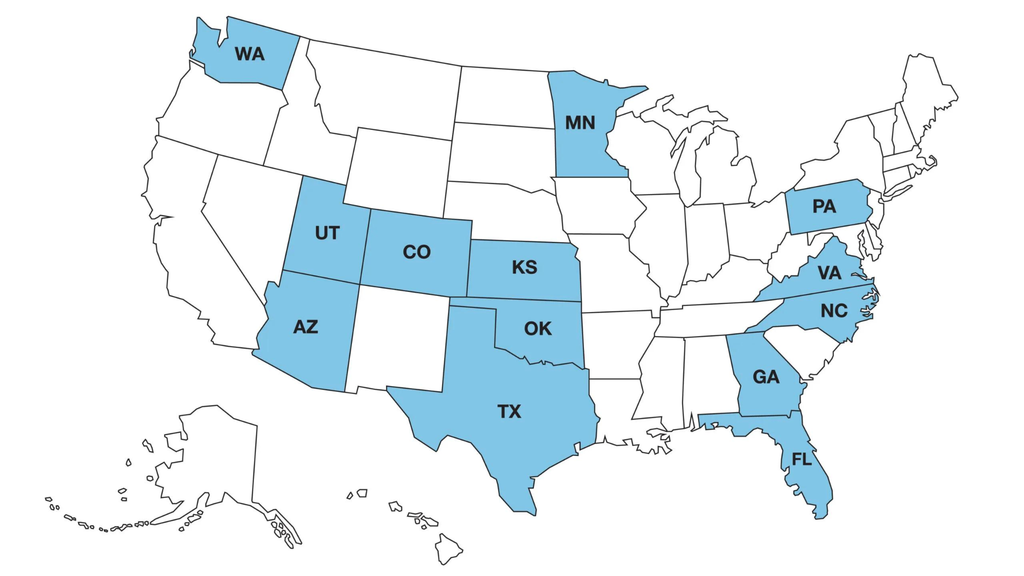
Pilot car certification requirements are established at the state level. According to Evergreen Safety Council’s May 2026 certification guidance, the following 14 states have some form of certification or qualification requirement for pilot car operators.
| State | Certification consideration |
| Arizona | State-recognized PEVO credentials |
| Colorado | Approved pilot escort qualifications |
| Florida | Escort training and supplementary driver training |
| Georgia | Recognized escort operator credentials |
| Kansas | Operator qualifications and additional registration |
| Minnesota | State-recognized certification |
| New York | Separate New York escort credential |
| North Carolina | Recognized pilot car certification |
| Oklahoma | Approved escort operator credentials |
| Pennsylvania | Specific qualifications for superload operations |
| Texas | Applicable flagger qualifications |
| Utah | Recognized certification and escort vehicle permitting |
| Virginia | State-issued or accepted reciprocal credentials |
| Washington | Approved PEVO certification |
Not all of these states require the same type of certification for every assignment. Some requirements apply to particular load categories, vehicle configurations or operational responsibilities. States without formal PEVO certification programs may still impose strict equipment, insurance, vehicle and escort operating requirements. This table is a planning reference rather than an exhaustive legal determination.
Always consult the relevant state authority before operating.
How Does Pilot Car Certification Reciprocity Work?
Certification reciprocity allows a pilot car operator certified in one state to use that credential in another state that recognizes it. This can reduce the need to complete separate training programs for every state through which an oversize load travels. However, reciprocity should not be confused with nationwide authorization.
A state may accept your certification while still requiring additional training, vehicle permits, insurance or other qualifications. Acceptance is not always mutual, either. One jurisdiction may recognize another state’s certificate without receiving the same recognition in return.
Washington State Pilot Car Certification Reciprocity
Washington is a useful example because its certification is recognized across several jurisdictions. According to published state and training-provider guidance, Washington’s PEVO certificate is accepted in the following states, subject to applicable local conditions.
| Destination state | Washington certification accepted? |
| Arizona | Yes |
| Colorado | Yes |
| Florida | Yes, subject to supplementary training |
| Georgia | Yes |
| Kansas | Yes, with additional permit requirements |
| Minnesota | Yes |
| New York | No |
| North Carolina | Yes |
| Oklahoma | Yes |
| Pennsylvania | Accepted for relevant operations, with additional training requirements |
| Texas | Accepted as a qualifying credential for applicable flagger requirements |
| Utah | Yes, with additional vehicle permitting |
| Virginia | Yes |
| Washington | Yes |
Recognition in these states does not mean that Washington certification holders are exempt from local regulations.
Important Exceptions to Certification Reciprocity
New York is a significant exception. The New York State Department of Motor Vehicles states that it does not recognize escort vehicle certifications issued by other states. Drivers undertaking operations that require New York escort qualifications must obtain the appropriate New York credential. Home-state restrictions can also affect which certification you need.
For example, drivers holding a Washington driver’s license must have a Washington PEVO certificate when performing escort duties in Washington. Virginia provides another example of interstate recognition. Its official escort driver certification page identifies reciprocal certification arrangements with Florida, Georgia, Minnesota, North Carolina, Oklahoma, Utah and Washington. These differences make it essential to check the rules for every jurisdiction involved in an assignment.
Which Pilot Car Certification Should You Choose?
The most suitable pilot car certification depends on your home state, intended operating territory and the services you plan to provide. If most of your work will take place within one state, completing its approved certification program may be the most practical option. If you intend to travel nationwide, a credential recognized by several states may offer greater flexibility. You may still need a separate certification for certain destinations.
Consider the following example.
A pilot car driver holding a Washington PEVO certificate accepts an assignment traveling through several western states. Before accepting the job, the operator must confirm that the credential is recognized throughout the route and determine whether additional vehicle permits are required. If that driver later accepts an assignment in New York that requires an escort certification, a separate New York qualification will be necessary. There is no single best certification for every operator. Choose your credentials according to the work you expect to perform.
How Much Does It Cost to Become a Pilot Car Driver?
The cost of becoming a certified pilot car driver depends on your training provider, certification requirements and whether you already own a suitable escort vehicle. For reference, published certification costs include:
| Certification or training | Published cost |
| Washington PEVO training through Evergreen Safety Council | From $265 |
| Virginia escort driver certification fee | $25, excluding training |
| New York escort driver examination | $40 per attempt |
| Evergreen Safety Council WITPAC training | From $325 |
These prices are specific examples, not nationwide averages, and are subject to change.
Additional Startup Expenses
Certification is only one part of the initial investment. Independent operators should also budget for vehicle purchase or modification, commercial insurance, warning equipment, communication devices, specialized training, registration and ongoing operating expenses.
Fuel, vehicle maintenance and travel between assignments should also be included when evaluating whether to start a pilot car business. Obtaining several quotations before purchasing equipment or insurance can help you establish a realistic startup budget.
Essential Equipment for Certified Pilot Car Drivers
Professional pilot cars need appropriate safety and communication equipment. The following checklist provides a general starting point.
| Equipment | Purpose |
| Oversize load warning signs | Alerts surrounding motorists |
| Amber warning lights | Improves vehicle visibility |
| Two-way radio | Supports communication with the transportation team |
| Safety flags | Provides additional visual warnings where required |
| High-visibility clothing | Improves personal visibility |
| Stop/slow paddle | Supports authorized traffic control |
| Fire extinguisher | Supports emergency preparedness |
| First-aid kit | Provides basic emergency supplies |
| Warning triangles or other approved devices | Helps warn approaching traffic |
| Height pole | Assists with overhead clearance checks when required |
| Navigation and route documentation | Supports route awareness and preparation |
Exact equipment specifications vary by jurisdiction and assignment. For example, Washington’s pilot and escort vehicle regulations establish specific vehicle, warning equipment and operating requirements. Always check the applicable rules before outfitting your vehicle.
Certification Renewal and Advanced Training
Pilot car certifications are generally issued for a defined validity period. Washington PEVO certification lasts three years, while Virginia’s escort driver certificate is valid for five years. New York’s expiration rules differ according to whether the operator holds a New York or out-of-state driver’s license. Renewal requirements may involve refresher training, examinations, fees or updated documentation. Keeping track of expiration dates is particularly important for operators holding multiple state certifications.
What Is WITPAC Certification?
Wind Industry Transportation Professional Advanced Certification, commonly known as WITPAC, is specialized training for transportation professionals involved in moving wind energy components. It addresses challenges associated with transporting equipment such as wind turbine blades and other large components. WITPAC complements foundational pilot car training but does not replace state-specific PEVO certification requirements. Other professional development opportunities include specialized height pole operations, route surveying and superload escort training.
What to Check Before Accepting Your First Pilot Car Assignment
Before accepting an assignment, make sure you understand the shipment, route and responsibilities involved.
Confirm that:
- Your certification is valid throughout the proposed route.
- Additional permits and qualifications have been obtained where necessary.
- Your insurance covers the proposed work.
- Your vehicle and equipment meet applicable requirements.
- You understand the shipment’s dimensions and escort requirements.
- Communication arrangements with the transportation team are established.
- You have the experience and equipment necessary for your assigned role.
Complex or unfamiliar routes may require further assessment before transportation begins. Good preparation helps protect both your professional reputation and the safety of the transportation operation.
Frequently Asked Questions
Q. Do you need a CDL to become a pilot car driver?
Generally, a CDL is not required to operate a standard pilot car that falls below commercial driver’s license thresholds. However, specialized vehicles, advanced assignments and certain state requirements may call for additional qualifications.
Q. Can you get pilot car certification online?
Yes. Some approved training providers offer online pilot car certification courses and remotely supervised examinations. Other states require classroom training or in-person testing. Confirm that the online course provides a credential accepted in your intended operating states.
Q. How long does it take to become a certified pilot car driver?
Some approved certification courses can be completed in a single day. Washington, for example, requires an eight-hour initial training course and a written examination. The complete process may take longer if additional testing, documentation or state approval is required.
Q. Is there a nationwide pilot car certification?
There is no single universal PEVO certification that automatically satisfies every state’s requirements. Some state-issued credentials are widely recognized through reciprocity, but operators must still comply with applicable local rules.
Q. Can I have more than one pilot car certification?
A. Yes. Operators may obtain multiple state certifications where eligible. This can be useful when working in states that do not recognize the operator’s existing credentials.
Q. Does New York accept Washington pilot car certification?
No. New York does not recognize escort certifications issued by other states. Operators must obtain the appropriate New York qualification for assignments subject to its escort certification requirements.
Q. Can I start working immediately after becoming certified?
Certification alone does not necessarily make you ready to accept every assignment. You must also meet applicable insurance, equipment, vehicle permit and operational requirements. Practical experience is especially valuable when working with complex oversize loads.
Q. How much do pilot car drivers earn?
Earnings depend on assignment rates, mileage, location, demand, experience and operating expenses. Independent operators should distinguish gross revenue from actual profit after fuel, insurance, maintenance and other business costs.
Start Your Pilot Car Career With 365 Pilots
A successful pilot car career begins with the right training, appropriate certification and a commitment to safe, professional operations. Understanding state certification requirements and reciprocity arrangements can help you avoid unnecessary expenses and prepare for interstate transportation assignments.
At 365 Pilots, we connect certified pilot car drivers with the heavy haul transportation industry. Our nationwide network supports oversize load movements through lead car, chase car, height pole, route survey and dispatch services.
Whether you are an experienced operator looking to expand your professional network or a carrier searching for qualified pilot car support, our team is here to help.
Contact 365 Pilots or call 1-866-795-0150 to discuss your pilot car service or operator network requirements.









Leave a Reply