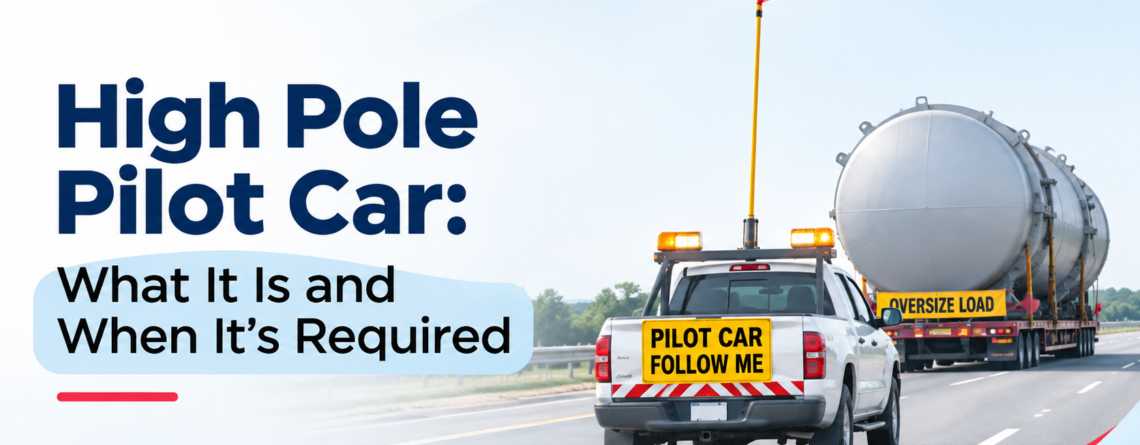
A high pole pilot car is a lead escort vehicle with a tall, non-conductive measuring pole mounted on its front bumper. The pole is set slightly above the height of the load it is escorting, usually about 6 inches higher. If the pole touches a bridge, wire, sign or traffic light, the driver radios the truck to stop before the load reaches it. Most states require a high pole car once a load is somewhere between 14’4″ and 17′ tall, depending on the state.
A bridge doesn’t move out of the way, and a power line doesn’t warn you before it arcs. For tall loads, the high pole car is the vehicle that finds a clearance problem while there is still time to stop.
What Is a High Pole Pilot Car?
A high pole pilot car, also called a height pole car or height pole escort, is a lead escort vehicle fitted with a long vertical pole on its front bumper. It drives ahead of an over-height load and tests every overhead object on the route before the truck reaches it:
Bridges and overpasses
Power, phone and cable lines
Traffic signals and sign gantries
Tree branches
Railroad crossing equipment
Toll plazas, canopies and drive-through structures
When the pole tip touches something, the driver radios the truck right away to stop, slow down or change lanes.
How a Height Pole Works
1. The pole is set above the load height
Before the move, the escort measures the load’s exact height and sets the pole tip about 6 inches above it. Some rules spell this out. Arkansas, for example, requires the clearance bar to extend 6 inches above the permitted height. That buffer covers the load bouncing on rough pavement and small errors in measuring.
Example: For a load that measures 16’2″, the pole is set at about 16’8″.
2. The pole must be non-conductive
Height poles are usually made of fiberglass or another non-conductive, flexible material, often with a breakaway or flexible tip. That matters because one of the main things the pole touches is power lines. A metal pole against a live line could electrocute the escort driver.
3. The car stays far enough ahead to stop the truck
The high pole car runs far enough ahead that the truck has room to stop safely after a strike call, usually several hundred feet depending on speed and conditions. If the escort sees a tight clearance coming up, it widens the gap.
4. Strike, call, stop
When the pole hits something, the escort calls it over the radio immediately. The driver stops or slows down, and the team checks whether the load will clear or needs a detour.
Pro tip: A height pole is a backup check, not a route plan. You should already know the clearances on your route before the move. For very tall loads, that means a route survey before moving day. The pole catches what the survey and permit didn’t, such as a sagging line or newly installed signs.
Why High Pole Escorts Matter: Bridge Strike Prevention
Over-height strikes are among the most expensive mistakes in heavy haul. One strike can lead to:
Bridge or infrastructure damage, which the carrier is often billed for
A destroyed load, such as a transformer, tank or piece of machinery
Downed power lines, outages and electrocution risk
Road closures and emergency response costs
Fines, permit violations and insurance claims
Injuries or deaths
Truckers say it plainly on industry forums: if a pole car misses an overhead obstruction and the load hits it, the bridge is still your responsibility. That’s why a well-insured, experienced high pole escort is worth paying for.
Height Pole Requirements by State
Each state sets its own height trigger. Here’s when a high pole escort is typically required in the states where 365 Pilots runs the most loads:
| State | Height Pole Required When Load Is… | Notes |
|---|---|---|
| Iowa | Over 14’4″ (up to 20′) | Above 20′, an escort is required but no pole |
| Illinois | Over 14’6″ | 3 escorts over 18′; State Police over 18′ |
| Indiana | Over 14’6″ | Height pole car must travel in front |
| Nebraska | Over 14’6″ (route-dependent) | Route survey required over 16′ |
| Kentucky | Over 14’11” | Applies on two-lane and four-lane roads |
| Arkansas | Over 15′ | Bar set 6″ above load; utility agreements over 17′ |
| Tennessee | 15’1″ and up | Front escort with height pole |
| Minnesota | Over 15’6″ | Must be non-conductive, flexible, breakable |
| Oklahoma | 15’9″ and up | 2 escorts plus advance utility/railroad contact |
| Kansas | Over 16′ | Non-conductive, flexible pole required |
| Texas | Over 17′ | Front escort with non-conductive height pole |
Based on published state DOT rules in 2026. Your oversize permit always takes priority over general guidelines.
What this means on a multi-state run: a 15-foot-tall load needs a height pole in Iowa, Illinois, Indiana and Kentucky, but not in Texas or Kansas. One run can switch between pole required and not required several times. Your escort team needs to know exactly where those changes happen.
For the full width, height and length rules, see our guide to pilot car requirements by state.
Which Loads Usually Need a High Pole Car?
Transformers and electrical equipment
Industrial tanks, vessels and boilers
Construction equipment such as excavators, cranes and drilling rigs
Modular buildings and manufactured homes with tall roof lines
Wind energy parts such as tower sections, nacelles and hubs
Agricultural equipment such as grain bins, combines and sprayers
Boats and yachts on tall trailers
If your load measures within a few inches of your state’s legal height (usually 13’6″ to 14’6″), talk to an escort company before you assume you’re clear.
What a Professional High Pole Escort Should Have
Non-conductive fiberglass pole with a flexible or breakaway tip
Adjustable mount so the pole can be set precisely for each load
“OVERSIZE LOAD” sign, amber lights and flags that meet state rules
Two-way CB or radio with clear, constant contact with the truck
State certification where required (for example, Oklahoma)
Commercial liability insurance that’s strong enough for over-height risk
Experience reading overhead hazards at highway speed, day and night
High Pole vs. Lead Car: What’s the Difference?
| Standard Lead Car | High Pole Car | |
|---|---|---|
| Position | In front of the load | In front of the load |
| Main job | Warn traffic, scout the road | Test overhead clearance |
| Equipment | Signs, lights, flags, radio | All of that plus a height pole |
| Needed for | Wide or long loads | Tall loads |
| Typical cost | Lower | Slightly higher per mile |
Many tall loads are also wide, so the high pole car often does double duty as the lead car, with a separate chase car behind. Learn more in our complete guide to pilot car services.
How Much Does a High Pole Pilot Car Cost?
High pole escorts usually cost a little more than a standard lead or chase car because of the extra equipment, skill and liability. Typical industry ranges run about $1.55 to $2.50 per mile, with daily minimums. Night moves, short-notice dispatch and route surveys add to that.
See the full breakdown in How Much Does a Pilot Car Cost? Rates Per Mile Explained.
Book a High Pole Pilot Car with 365 Pilots
365 Pilots provides high pole escorts nationwide, 24/7. Our height pole drivers run non-conductive poles set to your exact load height, keep constant radio contact with your driver, and are certified for the states on your route.
Our high pole service includes:
Pole set to your measured load height plus a safety buffer
Lead and chase escort pairings for tall and wide loads
Route surveys for very tall loads
Night moves where the permit allows them
Nationwide coverage, with one dispatch for your whole route
📞 Call 866-795-0150 or request a high pole pilot car.
Pilot car drivers: Have a height pole setup? Join the 365 Pilots network and get high pole loads nationwide.
Frequently Asked Questions
What is a high pole pilot car?
It’s a lead escort vehicle with a non-conductive pole mounted on the front, set just above the load’s height. It checks bridges, wires and signals before the oversize load reaches them.
How high is a height pole set?
Usually about 6 inches above the load height. Some states and permits set the exact buffer, so always follow your permit.
When is a height pole required?
It depends on the state. Common triggers are 14’4″ (Iowa), 14’6″ (Illinois, Indiana), 14’11” (Kentucky), 15′ (Arkansas), 16′ (Kansas) and 17′ (Texas).
Why must a height pole be non-conductive?
Because the pole may touch power lines. A fiberglass or other non-conductive pole protects the escort driver from electrical shock.
Does a height pole replace a route survey?
No. A route survey confirms clearances before the move. The height pole is a real-time backup that catches anything the survey missed.
What is a height pole escort?
It’s the same thing as a high pole pilot car: an escort vehicle that measures overhead clearance in front of a tall load.
Is a high pole car more expensive than a regular pilot car?
Usually a little. Typical high pole rates run about $1.55 to $2.50 per mile, compared with about $1.50 to $2.00 for a standard lead or chase car.