
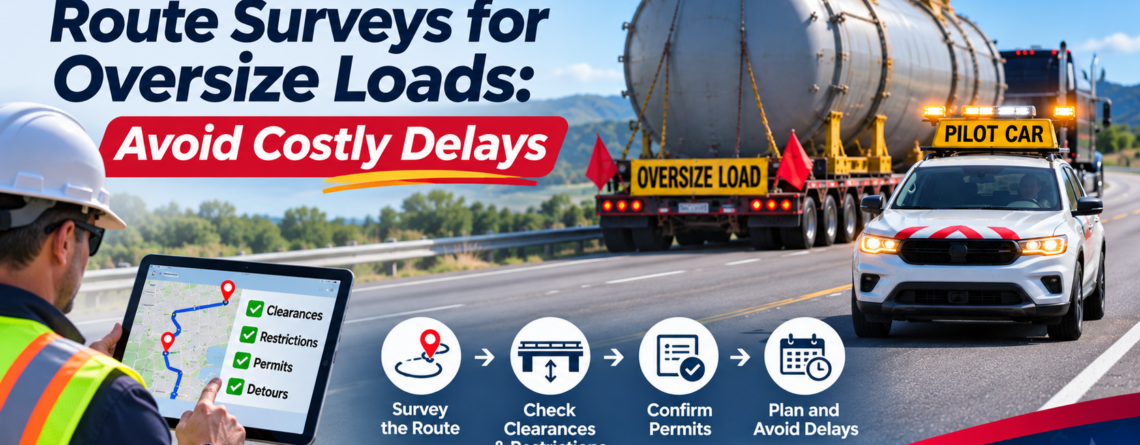
A low bridge, an unexpected road closure or a turn that a trailer cannot safely complete can bring an entire heavy haul operation to a standstill. By the time the problem is discovered, the truck is already loaded, pilot cars are on duty, and the receiving team may be waiting at the destination.
Route surveys for oversize loads help prevent these costly delays by identifying physical obstacles, clearance restrictions and access problems before transportation begins. They give carriers a better understanding of whether a planned route can accommodate the actual dimensions and configuration of a load.
For trucking companies, freight brokers and logistics managers, checking the route in advance can make the difference between a well-coordinated delivery and hours of avoidable downtime.
What Is a Route Survey for Oversize Loads?
A route survey is a detailed assessment of the roads an oversize load will travel. It typically involves physically inspecting the proposed route to identify obstacles, clearance limitations and other conditions that could affect safe transportation.
Unlike ordinary trip planning, a route survey considers the specific height, width, length, weight and configuration of the loaded vehicle.
Survey findings are usually documented in a report containing measurements, photographs, locations of potential hazards and recommendations for resolving identified problems.
The Federal Highway Administration’s pilot and escort vehicle training manual identifies accurate route surveys as an important part of safe oversize load transportation.
The goal is simple: discover problems while there is still time to address them.
Route Planning vs. Route Surveys: What's the Difference?
Route planning and route surveying work together, but they are not the same thing.
Route planning identifies a suitable path using road maps, transportation databases, permit restrictions and other available information. Route surveying checks the conditions along that proposed path.
| Route planning | Route surveying |
|---|---|
| Identifies a proposed travel route | Physically verifies route conditions |
| Uses maps and transportation databases | Uses observations, measurements and documentation |
| Reviews known road restrictions | Identifies potential obstacles along the route |
| Supports permit preparation | Helps confirm physical feasibility |
| Establishes the initial transportation plan | Provides additional information for executing the move |
A route may appear suitable on a digital map but still present difficulties for a particular trailer or load. Using both approaches helps carriers make better-informed transportation decisions.
How Route Surveys Prevent Costly Delays
Heavy haul transportation involves more than getting a truck from one location to another. It requires coordination between drivers, dispatchers, escort vehicles, permit authorities and receiving teams.
When something goes wrong along the route, the effects can extend well beyond the driver and the truck.
1. Identifying Low Bridges and Overhead Obstructions
Vertical clearance is a major concern when transporting tall machinery, industrial equipment and oversized structures.
A route survey can identify potential clearance problems involving bridges, overhead signs, traffic signals, pedestrian crossings, tree branches and utility lines.
Road resurfacing and infrastructure changes can also affect previously recorded clearances. General navigation tools may not contain the detailed or current information needed for a particular oversize load.
Discovering an obstruction before departure gives the carrier time to investigate an approved alternative route or coordinate with the appropriate authorities.
Discovering the same obstruction with a loaded truck already on the road creates a much more complicated situation.
2. Checking Tight Turns and Narrow Roads
A road may be wide enough for an oversize load to travel in a straight line but unsuitable for the turns required to reach its destination.
Long trailers need additional space when navigating intersections, roundabouts and access roads. Roadside barriers, poles and parked vehicles can further reduce the available room.
Route surveys help identify these restrictions before the truck arrives.
For example, a carrier transporting a long piece of industrial equipment might find that the planned highway exit leads to a narrow intersection with limited turning space.
Identifying that problem beforehand allows the transportation team to assess alternative access routes or arrange any necessary, authorized traffic control.
3. Identifying Bridge Weight Restrictions
Oversize and overweight loads present different challenges. A vehicle may have sufficient physical clearance to cross a bridge but exceed its permitted weight or axle-loading restrictions.
Route planning and surveying can help identify posted restrictions and structures that require further assessment.
However, a visual inspection alone cannot determine whether a bridge can safely support a heavy load. Structural suitability must be confirmed through the relevant permitting authority or an appropriate engineering assessment when required.
Finding these restrictions early helps prevent unexpected rerouting, permit complications and delays involving overweight transportation.
4. Accounting for Construction Zones and Road Closures
Road conditions do not remain the same throughout the year.
Construction projects, temporary barriers and lane closures can make previously suitable routes difficult or impossible for oversize loads to use.
A route survey can identify work zones and temporary restrictions that affect the available road space. Current transportation authority notices should also be checked before departure.
With this information, dispatchers can adjust schedules, coordinate approved alternative routes or arrange the necessary support before the truck begins its journey.
This is particularly valuable for deliveries with fixed unloading appointments.
5. Preventing Final-Mile Delivery Problems
Some of the most difficult parts of an oversize load journey occur near the destination.
Highways may accommodate the shipment without difficulty, but the final access road could contain a narrow entrance, sharp bend, low gate or restricted unloading area.
Consider a truck delivering heavy machinery to a construction site. The highway portion of the journey is completed successfully, but the site entrance cannot accommodate the trailer’s turning path.
The delivery is now delayed even though almost the entire trip went according to plan.
A thorough route survey considers access to the actual delivery location, not just the nearest major road.
When Is a Route Survey Required for an Oversize Load?
Route survey requirements in the United States vary depending on the state, load dimensions, permit conditions and proposed travel route.
There is no single nationwide height or width threshold that determines whether every carrier must complete a route survey.
Some permitting authorities require additional documentation for particularly large or complex shipments.
For example, Florida’s oversize load permit regulations require route verification before permitted movement and establish additional survey documentation requirements for certain larger loads.
Indiana’s oversize and overweight permitting system guidance also describes a survey approval process for very large shipments.
Even where a formal survey report is not specifically required, a professional route survey may be a sensible precaution when:
- Transporting unusually tall, wide or long equipment.
- Moving a superload or complex overweight shipment.
- Using unfamiliar roads or industrial access routes.
- Traveling through construction areas or congested cities.
- Working with tight delivery schedules and expensive unloading equipment.
Always confirm the current requirements with the relevant state and local permitting authorities before transportation.
How Much Can a Route Survey Save?
The cost of a route survey depends on the distance involved, the complexity of the load, the number of potential restrictions and the level of documentation or specialist assessment required.
The financial value of a survey becomes easier to understand when compared with the potential cost of an unexpected delay.
A delayed heavy haul shipment can result in additional truck operating expenses, pilot car standby charges, revised permits, fuel costs and missed unloading appointments.
An Illustrative Heavy Haul Delay Cost
Imagine a carrier transporting industrial machinery that encounters an unexpected clearance restriction. The problem results in a six-hour delay and additional transportation expenses.
| Expense | Illustrative cost |
|---|---|
| Truck downtime: 6 hours at $150 per hour | $900 |
| Two pilot cars: 6 hours at $75 per hour each | $900 |
| Crane crew standby: 4 hours at $350 per hour | $1,400 |
| Additional fuel and rerouting expenses | $350 |
| Administrative and permit-related expenses | $200 |
| Total potential delay cost | $3,750 |
If an advance route survey costing $800 identified the issue and allowed the carrier to resolve it without those additional expenses, the potential net savings would be $2,950.
These figures are hypothetical and are not industry-average rates or a 365 Pilots service quotation. Actual expenses and savings depend on the shipment and circumstances.
The example shows why evaluating a survey solely as an upfront expense can overlook its wider financial benefit.
Avoid surprise clearance problems before your truck rolls.
Oversize Load Route Survey Checklist
A useful route survey should reflect the specific shipment, rather than relying on a general inspection of the road.
The following checklist can help carriers and dispatchers determine whether the important areas have been considered.
| Survey area | What should be reviewed |
|---|---|
| Load dimensions | Loaded height, width, length and overhang |
| Vehicle configuration | Trailer type, axle layout and ground clearance |
| Vertical clearance | Bridges, overhead signs, signals and utilities |
| Road geometry | Lane widths, intersections, curves and turning space |
| Weight restrictions | Posted limits and required structural approvals |
| Temporary restrictions | Construction work, closures and detours |
| Railroad crossings | Potential grounding and crossing constraints |
| Stopping locations | Suitable fuel, rest and staging areas |
| Delivery access | Site entrances, internal roads and unloading access |
| Documentation | Measurements, photographs and route-specific observations |
Before departure, the transportation team should review the survey findings, confirm that identified problems have been resolved and ensure the intended route complies with the applicable permits.
How Early Should You Arrange a Route Survey?
There is no universal lead time for conducting a route survey.
A straightforward shipment may require less preparation than a complex superload traveling across several states. Moves involving utility coordination, structural assessments or additional approvals may require considerably more planning.
Begin arranging the survey early enough to resolve any problems that are identified. At the same time, avoid relying exclusively on information collected so far in advance that road conditions may have changed.
The transportation team should recheck relevant construction notices, route restrictions and permit conditions closer to the departure date.
Early planning creates time to solve problems. Updated verification helps ensure the plan remains suitable.
The Role of Pilot Cars in Route Surveying
Experienced pilot car operators can play an important role in identifying road hazards and supporting oversize load transportation.
A qualified survey operator may assess the proposed route, document potential clearance problems and provide information that helps the carrier prepare for the move.
During transportation, lead pilot cars, height pole vehicles, chase cars and other escort services perform different functions depending on the shipment and applicable regulations.
An advance route survey and a pilot car escort serve different purposes. The survey helps identify issues before departure, while escort vehicles provide support during the actual movement.
For complex shipments, coordinating both services can help keep the transportation team informed and prepared.
Choosing a Route Survey Provider
Price is an important consideration, but it should not be the only factor when selecting a route survey provider.
Look for a provider with relevant heavy haul experience, appropriate qualifications, clear documentation practices and an understanding of the regions your shipment will cross.
Ask what the survey covers, how identified restrictions will be reported, and whether additional measurements or specialist assessments may be necessary.
A completed survey should provide information that your driver and dispatch team can actually use when preparing for the move.
Frequently Asked Questions
Does every oversize load need a route survey?
Not necessarily a separate professional survey report. Formal requirements vary by jurisdiction, permit conditions and load characteristics. Carriers must verify the applicable rules and ensure that the planned route can accommodate their shipment.
Can Google Maps be used for oversize load route planning?
Google Maps can help with general navigation, but it should not be relied on as the sole planning tool for oversize loads. It does not provide every vehicle-specific clearance, axle restriction, permit condition or physical access detail required for heavy haul transport.
How much does an oversize load route survey cost?
Pricing varies according to route distance, load complexity, geographic coverage, urgency and documentation requirements. Request a quotation based on the actual shipment rather than assuming a standard nationwide rate.
Who performs route surveys for oversize loads?
Route surveys may be conducted by qualified pilot car operators, experienced transportation specialists or specialist survey and engineering providers. The appropriate provider depends on the scope of the survey and applicable requirements.
Can an existing route survey be used again?
Possibly, if the relevant permitting authority allows it and the previous survey remains suitable for the new shipment. Changes to load dimensions, road construction, infrastructure or permit conditions may require updated verification.
Is an oversize load permit enough to guarantee a safe route?
No. A permit authorizes movement subject to its conditions, but it does not eliminate every physical hazard or guarantee that road conditions will remain unchanged. Carriers must still verify route suitability and comply with permit requirements.
Plan Your Next Oversize Load Move With 365 Pilots
Unexpected transportation delays can be expensive, particularly when trucks, escort vehicles and unloading crews are working to the same schedule.
A professional route survey helps identify potential problems before they interrupt your shipment. Combined with appropriate route planning and pilot car support, it can help carriers prepare for a safer and more predictable journey.
365 Pilots offers route survey support, pilot car services, height pole services and nationwide dispatch assistance for oversize load transportation across the United States.Planning an upcoming heavy haul shipment? Share your load dimensions, proposed route and delivery schedule with our team.
Request route survey and pilot car support or call 1-866-795-0150 to discuss your transportation requirements.Call 1-866-795-0150 or book online.





Leave a Reply